
- Franchise Glossary
Everything You Need to Know About Franchise Terminology
Franchising has a language of its own, and understanding it is the first step toward evaluating any opportunity with confidence. This glossary covers the franchise terminology you will meet at every stage, defined the way we explain it to our own candidates: clearly, accurately, and without the jargon.
fran·chise
- noun, verb
- fran(t)ʃʌɪz
- FRAN-chyze
1. noun. The right granted by a company to an individual or group to operate a business under its brand, using its systems, products, and support. She bought a home services franchise in her hometown.
2. noun. The individual business operating under that right, including its territory and location.
3. verb. To grant such rights to others. The company began to franchise nationally in its fourth year.
On franchise pronunciation: the word has two syllables, stress on the first, and the second syllable rhymes with “prize,” not with “days.” Both the noun and the verb are said the same way. The franchise meaning above holds true across the industry, though the exact franchise definition applied to any specific opportunity is always set out in that brand’s Franchise Disclosure Document.
- Category 01
The Basics
The foundational terms behind every franchise conversation.
- Franchise Glossary
A business arrangement in which an established company licenses its brand, systems, and support to independent owners who operate local businesses under its name.
- Franchise Glossary
The structure that makes franchising work: the franchisor provides the brand, playbook, and training, while the franchisee provides the capital and local leadership.
- Franchisor
The company that owns the brand and operating system, sets the standards, and supports its network of owners.
- Franchisee
The individual who purchases the right to operate a business under the franchisor’s brand and system, owning and running the local operation.
- Master Franchisee
An owner who holds the rights to develop a brand across an entire region, often recruiting and supporting franchisees within it. Todd spent 17 years in this role, supporting more than 150 owners.
- Business Format Franchise
The most common model today, in which the franchisee licenses the complete operating system: brand, processes, training, marketing, and supply chain. Most modern franchise opportunities take this form.
- Product Distribution Franchise
An older model in which the franchisee primarily sells the franchisor’s products, with less emphasis on a shared operating system. Auto dealerships and beverage bottlers are classic examples.
- Conversion Franchise
An arrangement in which an existing independent business joins a franchise system, adopting its brand and standards while retaining its customer base.
- Franchise System
The complete set of methods, standards, and support that a franchisor provides and requires: the reason franchisees are not starting from scratch.
- Franchise Network
The collective group of owners operating under one brand. A healthy network shares knowledge, and speaking with it is the heart of validation.
- Brand Standards
The requirements every franchisee must meet on appearance, service, products, and operations, so that customers receive a consistent experience at any location.
- Unit
A single franchise location or operating territory. A franchisee may own one unit or many.
- Category 02
Documents and Legal Terms
The paperwork that protects you, and the items within it that deserve your closest attention.
- Franchise Disclosure Document (FDD)
The federally required document every franchisor must provide before a sale. It discloses the company’s history, fees, obligations, litigation, and franchisee contacts across 23 standardized items.
- FTC Franchise Rule
The federal regulation requiring franchisors to provide the FDD and governing how franchises may be offered and sold in the United States.
- Item 7
The section of the FDD detailing the estimated total initial investment, from the franchise fee through build-out, equipment, and initial working capital.
- Item 19
The financial performance representations: the only place a franchisor may lawfully share revenue or earnings figures. As Todd puts it, the proof is in the pudding.
- Item 20
The FDD section listing current and former franchisees with contact details, which is where meaningful validation begins.
- Franchise Agreement
The binding contract between franchisor and franchisee, setting the term, territory, fees, and obligations on both sides. Always reviewed with a qualified franchise attorney.
- 14-Day Disclosure Period
The minimum waiting period between receiving the FDD and signing anything or paying any money, built into federal law so candidates have time to review and seek advice.
- Territory
The defined geographic area in which a franchisee operates, which may be exclusive or non-exclusive depending on the agreement.
- Protected Territory
A territory in which the franchisor agrees not to open or license competing units of the same brand. The scope of that protection varies widely and deserves close reading.
- Operations Manual
The franchisor’s confidential playbook covering how the business is to be run day to day. It is typically referenced in the franchise agreement and becomes binding through it.
- Licensed Marks
The trademarks, logos, and brand assets a franchisee is granted permission to use, always under the franchisor’s ownership and standards.
- Renewal Term
The additional period a franchisee may operate after the initial term expires, usually subject to conditions and a renewal fee.
- Transfer
The sale or assignment of a franchise to a new owner, normally requiring franchisor approval and payment of a transfer fee.
- Right of First Refusal
A clause allowing the franchisor to match any third-party offer to buy a franchisee’s business before that sale can proceed.
- Non-Compete Clause
A restriction limiting what competing businesses a franchisee may operate during the agreement and for a period after it ends.
- Termination
The ending of a franchise agreement before its term expires, whether by the franchisor for cause or by mutual agreement. The FDD discloses how often this has happened.
- Category 03
Money and Franchise Investment Terms
The financial vocabulary of buying a franchise. Exact figures always come from each brand’s FDD.
- Franchise Fee
The upfront fee paid to the franchisor for the right to join the system, covering initial training and onboarding. It is set in the FDD and is the same whether or not you work with a consultant.
- Royalty
The ongoing fee, usually a percentage of gross revenue, paid to the franchisor for continued use of the brand and system.
- Marketing Fund Contribution
A recurring contribution toward the brand’s collective advertising, separate from any local marketing you run yourself.
- Technology Fee
A recurring charge covering the franchisor’s software, point of sale systems, and digital infrastructure.
- Initial Investment
The all-in cost of opening, detailed in Item 7: franchise fee, build-out, equipment, inventory, and initial working capital.
- Working Capital
The cash reserve that carries the business through its opening months, before revenue reliably covers expenses. Underestimating it is among the most common first-year mistakes.
- Liquid Capital
Cash and easily accessible assets available to invest, one of the first figures franchisors use to qualify candidates.
- Net Worth Requirement
The minimum total assets minus liabilities a franchisor requires of candidates, listed brand by brand.
- SBA Loan
A small business loan partially guaranteed by the US Small Business Administration, one of the most common financing routes for first-time franchise owners.
- ROBS (Rollovers as Business Startups)
A structure allowing retirement funds to be invested in a business without early-withdrawal penalties. Legitimate and common, but it places retirement savings at risk and requires a qualified provider.
- Franchisor Financing
Payment plans or lending programs offered directly by some franchisors, often covering part of the initial franchise fee.
- Veteran Incentive
A reduced franchise fee or enhanced support offered to military veterans by many franchisors, frequently through the industry’s VetFran program.
- Break-Even Point
The moment a business’s revenue covers its costs. How long this takes varies by brand and market, and existing owners are the best source of a realistic answer.
- Unit Economics
The profitability of a single location once it is running: revenue, costs, and margin per unit. The clearest measure of whether a business model works.
- Gross Revenue
Total sales before expenses, and the figure most royalty calculations are based on. Worth distinguishing carefully from profit.
- EBITDA
Earnings before interest, taxes, depreciation, and amortization: a common measure of operating profitability, and a figure buyers use when valuing a business at resale.
- Development Fee
A fee paid upfront by an owner committing to open multiple units, securing the rights to a larger territory or schedule.
- Transfer Fee
The fee payable to the franchisor when a franchise changes hands, covering approval and training of the incoming owner.
- Category 04
People and Process Terms
Who you will meet and what each stage means as you move toward a decision.
- Franchise Consultant
An advisor who helps candidates clarify their goals and evaluate prescreened opportunities, compensated by the franchisor rather than the candidate. The industry sometimes says broker; we say consultant, because guidance rather than transactions is the job.
- Candidate
You: a person exploring franchise ownership. The word matters, because until the right fit exists, there is nothing to sell.
- Franchise Attorney
A lawyer specializing in franchise law who reviews the FDD and franchise agreement on your behalf. Engaging one before signing is standard practice, not an optional extra.
- Prescreening
The stage where a consultant evaluates opportunities against your goals before you invest serious time, filtering hundreds of brands to a ranked shortlist.
- Validation
Direct conversations with existing franchisees about their real experience: earnings, hours, support, and what they wish they had known. The most important homework in the entire process.
- Discovery Day
A structured visit to the franchisor’s headquarters, late in the process, where you meet leadership and both sides confirm the fit. Some brands call it confirmation day.
- Franchise Development
The franchisor-side function responsible for awarding franchises and growing the network, the team you will interact with during your evaluation.
- Awarded
The language franchisors use when approving a candidate. Franchises are awarded rather than simply sold, because the franchisor is also deciding whether you are the right fit for them.
- Initial Training
The formal program every new franchisee completes before opening, covering operations, systems, marketing, and staffing.
- Field Support
The franchisor representatives who visit and advise owners after opening. The quality of this support is one of the most revealing things to ask about during validation.
- Franchise Advisory Council
A group of elected franchisees who represent owner interests to the franchisor. Its existence, and how seriously it is taken, says a great deal about a brand’s culture.
- Ramp-Up Period
The months between opening and reaching stable operating performance, when working capital and patience matter most.
- Category 05
Ownership and Operations Terms
The models that determine what your daily life as an owner actually looks like.
- Owner-Operator
Hands-on, daily involvement as the driving force of the business, with direct control over operations. Common in personal and home service franchises.
- Executive Owner
Leadership through a manager or team, with the owner focused on performance, finances, and direction rather than daily operations.
- Semi-Passive Ownership
Part-time, indirect involvement in a business designed to run without the owner’s daily presence, often chosen by owners keeping a career while they build.
- Single-Unit Franchise
Ownership of one location or territory, and the most common starting point for first-time franchise owners.
- Validation
Direct conversations with existing franchisees about their real experience: earnings, hours, support, and what they wish they had known. The most important homework in the entire process.
- Discovery Day
A structured visit to the franchisor’s headquarters, late in the process, where you meet leadership and both sides confirm the fit. Some brands call it confirmation day.
- Franchise Development
The franchisor-side function responsible for awarding franchises and growing the network, the team you will interact with during your evaluation.
- Awarded
The language franchisors use when approving a candidate. Franchises are awarded rather than simply sold, because the franchisor is also deciding whether you are the right fit for them.
- Initial Training
The formal program every new franchisee completes before opening, covering operations, systems, marketing, and staffing.
- Field Support
The franchisor representatives who visit and advise owners after opening. The quality of this support is one of the most revealing things to ask about during validation.
- Franchise Advisory Council
A group of elected franchisees who represent owner interests to the franchisor. Its existence, and how seriously it is taken, says a great deal about a brand’s culture.
- Ramp-Up Period
The months between opening and reaching stable operating performance, when working capital and patience matter most.
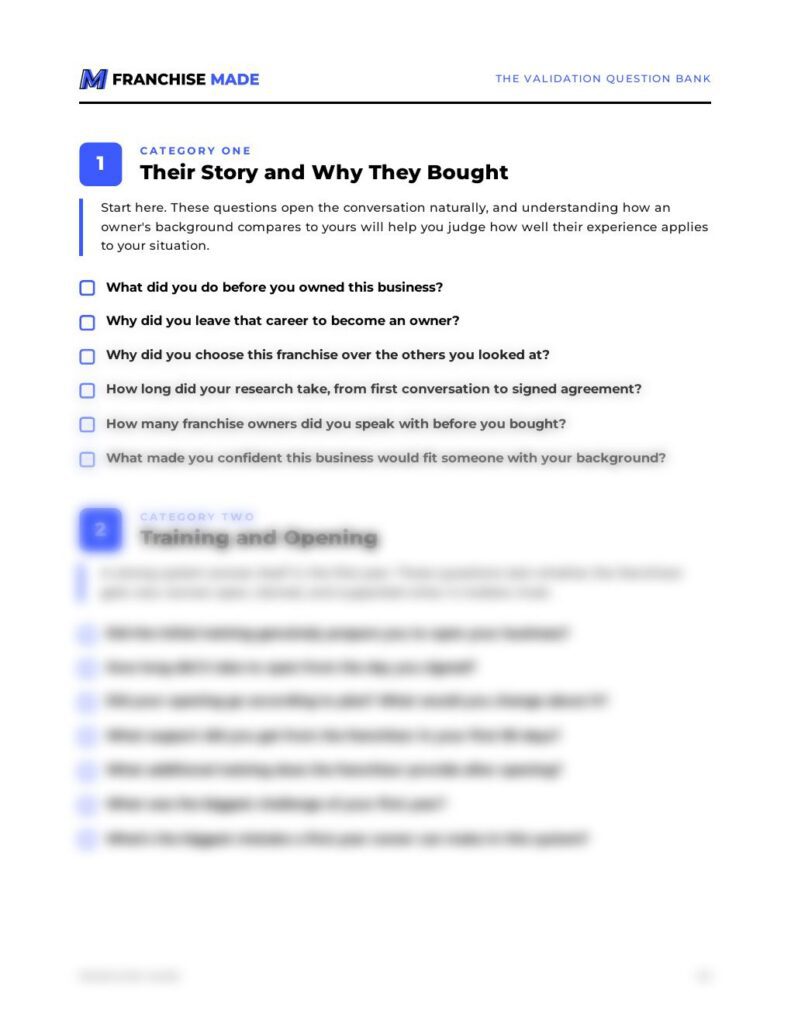
Free question bank
The Franchise Validation Question Bank
55 questions to ask existing franchise owners before you sign anything, organized into nine categories and ready to print for your validation calls.
Immediate download. Making your preparation a little easier.
Put These Terms Into Context on Our Blog
Founder Story: Todd Mayo
Before he advised anyone on buying a franchise, Todd Mayo spent 17 years running a franchise system, grew it to

Senior Care Franchise: A Mission-Driven Business for the Right Buyer
Quick answer A senior care franchise is a business that supports older adults and their families, usually through care services
How to Become a Franchise Owner: A Step-by-Step Guide From Salary to Ownership
Quick answer The steps for how to become a franchise owner start with your finances and end with a signed
Ready to Build Something That's Yours? Your Next Chapter Starts Here
The thing I hear most from franchise owners is “I wish I had started earlier.” You don’t have to decide anything today. Start with the franchise fit quiz and see where you stand, or skip straight to a 1:1 conversation with me. – Todd