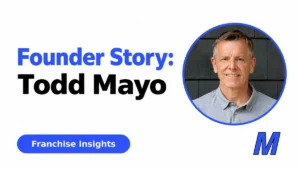
Before he advised anyone on buying a franchise, Todd Mayo spent 17 years running a franchise system, grew it to 150 franchise owners, and sold it. This is the story of how that life became his work.
Todd sat alone in a coffee shop, waiting for a woman who had agreed to sell him her business. The two of them had spent four months arriving at that table, working through negotiations, site visits, due diligence and long conversations about the people who worked for her, and both of their attorneys had already signed off on the agreement. All that remained was a cup of coffee and a signature, and when he spoke to her by phone that morning, she told him she was on her way.
Fifteen minutes passed before he called her again. She apologized and explained that she had changed her mind, and that she wouldn’t be coming after all.
At the time, Todd had recently sold his own franchise company, and he came to that meeting with capital, patience and years of ownership behind him. Even so, two years into his search, he still had nothing to buy. The experience left him with a conviction he now shares with nearly every candidate who calls him: buying a business is difficult, and buying one alone is harder still.
Today Todd is the founder of Franchise Made and an independent consultant within the FranChoice network, and much of his work is devoted to making sure the people he advises do not lose the years he lost. His record helps explain why they listen. He has spent 25 years in business ownership and has been a partner or sole owner of five businesses, four of them in franchising. For 17 of those years he was a master franchisee, a role in which he effectively served as the franchisor for his markets.
- Role: Founder of Franchise Made and an independent franchise consultant with FranChoice
- Home base: San Diego, California
- Ownership: 25 years in business ownership, with five businesses owned as a partner or sole owner, four of them in franchising
- Franchisor experience: 17 years as a master franchisee in commercial cleaning and maintenance, grown to 150 franchise owners across two markets before a sale to a local buyer
- Cost to candidates: Nothing for his consulting. Franchisors compensate Franchise Made when an introduced candidate buys a franchise. Independent attorneys, accountants, and lenders charge for their own services.
A Business Education That Began at Home
Todd’s understanding of ownership began long before he owned anything himself. His father never held a W-2 job, running his own business instead, and his son grew up watching both its rewards and its heartaches at close range. There were years when the business was strong and the household felt secure, and there were years when the economy turned against it, most memorably during the oil crisis of the 1970s, when forces far beyond his father’s control struck the business hard.
From that childhood, Todd drew two lessons that would shape the rest of his career. The first was that ownership could provide a family with a good life. The second was that it could just as easily leave that family exposed to circumstances no owner could prevent, and for years afterward he searched for a way to keep the promise of the first lesson while protecting himself from the second.
From Sales to Startups, and a Decision About Minneapolis
Todd studied marketing, but he soon noticed that most entry-level marketing jobs were largely administrative and paid poorly, so he went into sales straight out of college. He proved to be good at it, rose into management, received formal management training and eventually left the corporate world to join a series of startups.
Those startups gave him an education that a large company could not. Alongside his work in sales and marketing, he gained exposure to finance, fundraising, accounting and human resources, and he discovered that learning every part of a business did not intimidate him. Some of those ventures were highly successful, while others, as he puts it, were giant failures, but the pattern that emerged was always the same. Every few years a startup either sold, which was always the less likely outcome, or it failed, and in either case Todd found himself looking for his next job.
The turning point came after one of those successes, when his position was moved from San Diego to Minneapolis. His family was in San Diego, as was the weather he had no intention of giving up, and so he declined the move and found another job. The decision itself was easy, but the moment stayed with him, because as a father of two with a mortgage, he had no desire to spend three to six months searching for work every time a company won or lost.
The Year He Spent Asking the Wrong Question
By the age of 37, Todd had built and led sales and marketing teams in the medical device industry, yet he was not an engineer and knew he would never invent a device of his own. Remaining in the field meant finding a technical partner or being invited onto the right startup team, and he spent the better part of a year trying to solve that problem without success.
The answer came from a friend who had bought a franchise. The friend urged him to stop thinking about his industry and the people he knew, and to think instead about what he was genuinely good at and which of those skills would carry over to the opportunity in front of him. For Todd, the honest answer was sales, marketing, management and building culture, and he went on to find a business that depended heavily on exactly those strengths, backed by a franchisor that could supply the expertise he lacked.
“I believe strongly that understanding who you are, what you’re good at, what you’re not good at, and having that conversation with someone who knows you or can get those answers out of you can then help you be guided into opportunities that match those skill sets.”
Todd Mayo
Founder and Lead Franchise Consultant, Franchise Made

Seventeen Years in Commercial Cleaning
The friend owned the same franchise in the Bay Area and was six to twelve months further along, so when the business became available in Todd’s own market, he bought it as a master franchisee. In that role he was effectively the franchisor, and he built a team whose job was to support the local franchise owners who ran the work in the field. Looking back, Todd recognizes that his friend had served as an informal franchise consultant long before he knew such a role existed, coaching him through the process and telling him what to look for.
The company cleaned and maintained commercial buildings, and Todd valued three qualities in particular. Demand held steady through recessions, because buildings still need cleaning when budgets tighten, even if their owners cut back. He did not have to manage a large field staff, since his team supported the franchise owners and those owners ran their own cleaning crews. And because revenue came from ongoing contracts, the months ahead were unusually easy to anticipate.
“I always knew 60 to 90 days within 2 to 3% of what my revenue was going to be coming in. And that created a lot of peace in my life and calmness and stability and enabled me to make additional investments.”
Todd Mayo
Founder and Lead Franchise Consultant, Franchise Made
He had gone into business partly to protect his family financially, but also to create a life in which his weekends were free and his afternoons belonged to his children. The model gave him both, and he believes that if he had chosen a different business at that point in his life, the twenty years that followed would not have been nearly as enjoyable.
Over 17 years, Todd grew the system to 150 franchise owners across two markets. By his estimate, roughly half of those owners were Hispanic immigrants, a community to which he still feels closely connected. About five years before he sold the company, a personal matter kept him away from the business for most of a year. When the business continued to grow in his absence, he had the clearest possible proof that the management team he had built could run it without him.
An Exit, and a Hard Lesson in Buying
As 2020 approached, the business was still growing, but Todd’s enthusiasm for it had faded. Regulatory changes in his market had made the model less appealing, and rather than spend the coming years contending with them, he accepted an offer from a local buyer.
He had also owned a couple of other franchises with partners, one of which did much of its work in large stadiums and arenas. When the COVID-19 pandemic prevented crowds from gathering, that work largely disappeared for about a year, and the partners eventually sold the business.
With capital from his sale, Todd began looking for his next company, weighing existing franchises in his market alongside a handful of independent businesses. What he learned surprised him. The strongest businesses rarely appeared in public listings, and both of his own sales had come about through personal introductions rather than a listing site or an intermediary. The businesses advertised online, he came to realize, were often the ones nobody had quietly acquired, and there was usually a reason for that.
Even a promising opportunity carried its own risks. Many sellers had never sold a company before and were understandably anxious, and some relied on a personal attorney who was capable in general legal matters but inexperienced in mergers and acquisitions. It was in the middle of this long and frustrating search that the morning at the coffee shop arrived.
How Franchise Consulting Found Him
Throughout that search, Todd’s phone kept ringing. His sister called, and so did a neighbor and a friend of a friend, most of them in their forties, fifties or sixties. Some had sold a business and others had been downsized, but all of them wanted to own something and none of them knew where to begin.
One friend, frustrated with real estate, told him he wanted to open a pretzel shop in a busy tourist area. Rather than argue, Todd asked questions. He wanted to know who would staff the shop, and when the answer was summer workers and high school students, he asked whether his friend had ever managed teenagers, which he had not. He asked whether his friend would be willing to come in at 6 a.m. and make the pretzels himself when two employees failed to show up, and what the shop would be worth once the lease ran out, which in Todd’s estimation would be very little.
Those questions became the foundation of the method he uses today, in which a candidate’s goals for income, time and lifestyle come first and the product itself comes last.
“The business, the widget, the service, it doesn’t matter as much as meeting your lifestyle goals, your financial goals.”
Todd Mayo
Founder and Lead Franchise Consultant, Franchise Made
Eventually, the person to whom Todd had been referring these friends pointed out that he was already doing the work of a franchise consultant. He understood the material instinctively, they told him, and he did not need to be trained, and they invited him to join their team. That invitation brought him to FranChoice.
Todd describes the transition simply, saying that the work found him rather than the other way around. He had long assumed that his experiences would one day become stories told to grandchildren who had little interest in hearing them. Instead, he found that a great many people wanted to follow the path he had taken, and that what he had learned along the way had real value to them.
Inside Todd’s Franchise Consultancy Today
FranChoice was founded more than two decades ago by Jeff Elgin, whom Todd regards as a grandfather of the franchise consulting industry. By Todd’s count, the network includes roughly 90 independent consultants supported by a small home office, which prescreens franchisors before they join the portfolio and continues to review them long after they do.
Two or three times a week, Todd joins calls in which franchise companies share updates on their businesses, and twice a year the consultants and franchisors meet in person. At those gatherings, which Todd has written about after one such meeting in New Orleans, franchisors rotate through small groups to deliver 10- to 15-minute updates on their growth, the changes they have made and the owners they hope to find. Todd often learns the most over breakfast or during the breaks, when he might sit beside a founder such as the woman behind a Pilates studio concept and listen to her story. That time allows him to judge cultural fit from both sides of a potential match, rather than simply introducing two strangers who met online.
Franchise Made is Todd’s independent brand. Angela Fajardo, the firm’s business development manager, supports its marketing and operations, and his daughter helps as well.
Life First, Business Last
His consulting process begins with three meetings and a questionnaire, and it is designed to understand a candidate’s household as well as the candidate. Todd wants to hear from both spouses, and he asks how old the children are, whether an adult child may one day need care, and whether a son or daughter might eventually join the business. From those conversations he builds a ranked list of what the business must deliver, including income, hours, working days, the skills it demands and the pride a candidate would feel in owning it. He will not steer anyone toward a business they would be embarrassed to discuss with friends, and he is equally unwilling to steer them toward a worthy business that cannot meet their financial goals.
“I rank them and then I come to them with a fit. I say, hey, this one checks all the boxes. This one checks four of the five. This one only checks three. But the three that it checks are your top three.”
Todd Mayo
Founder and Lead Franchise Consultant, Franchise Made
How Todd Tests a Franchise System
To help candidates distinguish a strong franchisor from one that merely presents well, Todd directs them to two sources. The first is Item 19 of the franchise disclosure document (FDD), where a franchisor may describe how its existing franchise owners perform financially. The second is the list of current franchise owners that every FDD contains, and he encourages candidates to call three to five of them to ask what the franchisor promised and what it actually delivered.
He places considerable trust in those conversations because existing owners have little reason to mislead anyone. A candidate who joins the system may well be sitting beside that same owner at a conference within six months, and no franchise owner wants to be remembered as the person who gave a newcomer bad information. For financial questions, Todd refers candidates to an independent certified public accountant (CPA). His own guidance costs candidates nothing, because franchisors compensate Franchise Made when an introduced candidate buys a franchise, although independent attorneys, accountants and lenders charge for their own services.
Honest Advice, Even When It Means Waiting
Todd believes that anyone who has proved to themselves that they can lead should have the conversation about ownership. That proof might take the form of a string of promotions, a boss who hands them the keys whenever they travel, or colleagues who bring them the problems no one else is willing to raise. Those were precisely the signals that once gave him the confidence to take the step himself.
The conversation does not always end with a recommendation to move forward, however. Starting a franchise requires some liquid capital, and when a candidate’s finances are tight, Todd’s advice may be to spend a year raising a credit score and adding to savings before returning to the discussion. “And that might be the best piece of advice,” he says.
He is equally direct about the hours and the risks involved. A candidate who keeps a job while opening a business, as Todd did with his own first venture, may spend 40 hours a week on the new business and another 30 to 40 on the old job. It is a schedule that asks a great deal of any family. He also tailors his advice to a candidate’s stage of life. Someone under 50 who commits their savings still has time to recover if things go wrong, but someone in their sixties who would have to borrow against a home deserves a slower and more cautious conversation.
Decades of watching franchise owners have also taught him who tends to struggle. People who prefer to stay behind a closed office door, who avoid customers and who retreat from customer problems usually find franchising difficult, while the owners who do best tend to be energetic and at ease with people. His wife has teased him that he can chat with anyone, and he used to joke that sales was his only real skill. He now regards that ease with people as one of the most valuable traits an owner can bring to most franchise systems.
The sentiment he hears most often from franchise owners serves as a gentle warning to anyone who is still deciding. “I wish I would have started earlier,” they tell him.
What the People He Guides Say About Him
Angel Proa met Todd at a franchise convention in Los Angeles, where he and his wife were walking the floor, surrounded by brands and feeling thoroughly lost, when Todd stopped to talk with them. Proa, a first-generation immigrant, had spent 16 years in the automotive industry and had previously closed a business of his own that lacked structure. He was looking for a proven system, more time with his family and a way to change his family’s future.
“He is very genuine. He’s not pushy. He doesn’t want to sell you anything. He’s just there to share his knowledge.”
Angel Proa
Surface Experts franchise owner
When the FDD overwhelmed him, Todd showed him which pages mattered most, and when he grew nervous about his validation calls, Todd gave him questions to ask and called him back after every conversation to talk through the answers. Proa was surprised to discover that franchisors evaluate candidates just as carefully as candidates evaluate them. After narrowing his options to two brands, he chose Surface Experts for the personal support its team offered, and he describes working with Todd as life-changing.
Angela Fajardo, who works alongside Todd every day, describes a man who adapts naturally to whoever is in front of him. “He always brings himself to be where you’re at,” she has said. “He’s never talking over your head.” When Todd meets a candidate who is nervous about speaking English as a second language, he will sometimes begin speaking in his own imperfect Spanish, and the candidate usually relaxes enough for a real conversation to begin. He regards first-generation Hispanic families as a group that has often been overlooked when it comes to business ownership, and changing that is one of the goals he has set for his practice.
The Time He Wants to Give Back
The morning at the coffee shop cost Todd time he will never recover, and much of his work now is devoted to protecting other people’s time. A conversation with him costs nothing, he tells candidates, beyond perhaps five to ten hours spread across two to three months of discovery. For anyone who feels drawn toward ownership and wrestles with the fear that often comes with it, he believes that is a modest price for clarity.
It is also the reason candidates seek him out. They want the perspective of someone who has already been the franchise owner, the franchisor, the buyer and the seller, and who can tell them honestly what each of those roles demands.
Start With a Conversation
Talk with Todd about whether franchise ownership fits your goals, your finances, and the life you want. There’s no cost for his consulting. Franchisors compensate Franchise Made when an introduced candidate buys, and independent attorneys, accountants, and lenders charge for their own services.